Why Being Listed as ‘Additional Insured’ Isn’t Enough for Short-Term Rental Managers
You manage the property. You sign the contracts. You handle the guests. So why are you still relying on your client's homeowners’ insurance policy to protect you?
Here's something most short-term rental managers don't find out until it's too late: being listed as "additional insured" on your clients' homeowners’ or landlord policies does not protect your management business. Not for the claims that matter most. Not for your professional decisions. And not for the risks that come with running a vacation rental management operation day to day.
This isn't a loophole or a technicality. It's a fundamental gap in how additional insured status works, and it's one of the most dangerous misconceptions in the short-term rental industry. This guide explains exactly why short-term rental manager insurance is a separate, non-negotiable layer of protection, and what it covers that no client policy ever will.
What ‘Additional Insured’ Actually Means
When a property owner adds you to their policy as an ‘additional insured’, whether that's a homeowner's policy, a landlord policy, or a specialty STR product like Proper Insurance, you receive limited, secondary protection under their policy for claims tied to their property.
The key word is secondary. The policy was written for them, underwritten for their risk profile, and issued in their name. You are an afterthought on that policy, protected only in specific, narrow circumstances where a claim connects back to that property and implicates you as a manager.
That's it. That's what additional insured gets you.
It was never designed to function as a short-term rental management insurancepolicy for your business. It doesn't cover your operations. It doesn't cover your decisions. And in many scenarios, it doesn't even cover you for the property it's attached to like you thought.
4 Gaps as an ‘Additional Insured’ That Put Your Business at Risk
1. Your Professional Decisions Are Never Covered
This is the biggest gap and the one most managers never see coming.
Additional insured status covers premises liability: physical incidents at the property. A guest slips. A fixture falls. Something breaks. That's what the policy was written for.
What it does not cover is professional liability: the decisions you make as a manager. And those decisions are where your real exposure lives.
What if you set a nightly rate too low during peak season and that decision cost an owner thousands in lost revenue? That's an Errors & Omissions (E&O) claim, and no client’s policy will cover you. What if you miss a permit renewal and the property gets fined or shut down? That’s another E&O claim that won’t be covered. What if you make a booking error that leads to a double-booking and a furious guest? E&O claim. Or if you decide a maintenance issue can wait and it escalates into a $40,000 repair? E&O claim.
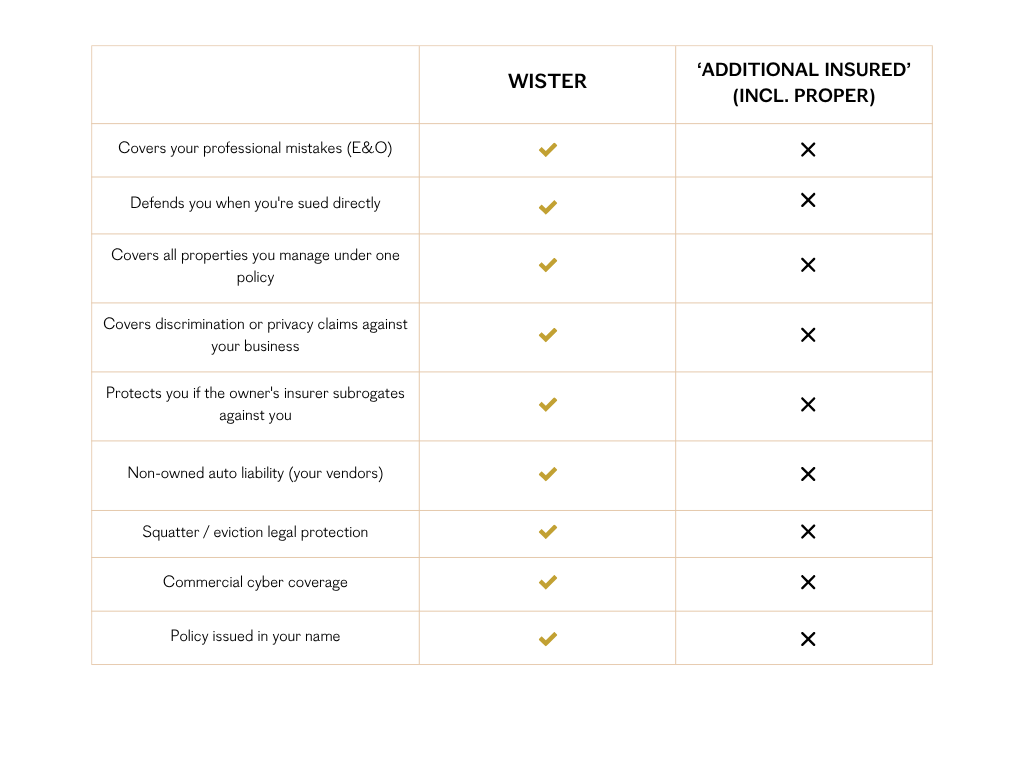
Every single one of these scenarios, and hundreds more like them, is a professional liability exposure. And every single one of them is excluded from the ‘additional insured’ coverage on your clients' homeowner or landlord policies.
E&O insuranceis the coverage that protects your management business from claims about how you do your job. It doesn't exist on any owner's policy. It only exists on a short-term rental management insurance policy issued in your name.
2. When You're Sued Directly, You're Defending Yourself
An owner's policy is designed to defend the owner. When you're added as additional insured, the insurer's legal obligation is to them first. If a guest, a neighbor, or even the property owner files a lawsuit naming your management company directly, the owner's insurer has no obligation to step in and defend your business with the same priority as their primary insured.
In practice, this means two things can happen: either the insurer defends the owner and leaves you to find your own counsel, or they defend both of you under the same policy, which creates a conflict of interest the moment your interests and the owner's interests diverge in the claim.
Either way, you are not in control of your own defense. A short-term rental manager insurance policy from Wister gives you your own dedicated policy, your own defense limits, and your own legal representation, in your name, for your business.
3. The Owner's Policy Can Be Denied Entirely, Taking Your Coverage With It
Many homeowners and landlord policies exclude short-term rental activity. If a property owner is using a standard homeowners policy and hasn't properly disclosed that the property is operating as a short-term rental, the insurer can deny the entire claim the moment they find out. And when the underlying policy is denied, your additional insured status disappears with it. There is no coverage to extend to you if the policy itself is voided.
Even specialty STR products aren't immune. Coverage terms, exclusions, and endorsements vary by policy. If the owner's policy has an exclusion that applies to the circumstances of the claim, that exclusion applies to you too.
4. Discrimination, Privacy, and Business-Level Claims
When a prospective guest alleges that your company discriminated against them in the booking process, that claim is against your business, not the property, not the owner. When a neighbor claims your management of the property violated their right to privacy, that claim is against your operations. When a former client alleges that your marketing misrepresented the property, that's an advertising injury claim against your company.
None of these are covered by additional insured status on an owner's policy. All of them are covered under properly structured vacation rental manager insurance.
What Happens When a Claim Falls Through the Cracks?
Let's make this concrete.
You manage 20 vacation rentals. You're listed as additional insured on every single owner's policy. A guest at one property slips near the pool, sustains a serious injury, and files a lawsuit naming both the property owner and your management company.
The owner files a claim with their insurer. Here's what unfolds:
The insurer opens a claim and assigns counsel to defend the owner.
During the investigation, they determine that the pool area wasn't properly maintained, which was an oversight in your management operations.
They pay the owner's portion of the claim.
They then subrogate against your management company: meaning they come after you to recover what they paid, on the grounds that your negligence caused the loss.
What about your additional insured status on that policy? It protects you from the guest's direct claim. It does not protect you from the owner's insurer coming after your business.
Now you need your own legal defense, your own coverage for the subrogation claim, and your own resources to fight it. None of which you have because you've been relying on policies that were never yours.
This is exactly the kind of claim documented in our real-world case studies. It happens more than you'd think.
Proper Insurance vs. Wister Insurance: What's the Difference?
If your clients carry Proper Insurance, you may feel like you're in better shape than most. Proper is a well-built product designed specifically for short-term rental owners, it's far more appropriate for the STR space than a standard homeowners policy.
But Proper is still a property owner's policy. And Wister is a short-term rental manager's policy. These serve different people with different risk profiles, and one cannot substitute for the other.
When an owner carries Proper and adds you as additional insured, you still have no E&O coverage, no dedicated defense in your name, and no protection for the professional and operational risks of running a vacation rental management business. The Proper policy protects the owner's asset. It does not fully protect your company.
Proper protects the asset. Wister protects your business. Both have a place, but only one of them is built for you.
What Short-Term Rental Manager Insurance Actually Covers
Wister Insurance was built from the ground up for short-term rental managers, vacation rental management companies, and Airbnb and VRBO co-hosts. Not owners. Not individual hosts. You.
As a coverholder of Lloyd's of London, backed by an AM Best A+ rated carrier, we built an insurance program from the ground up specifically for the short-term rental managment industry. That means you're not piecing together a patchwork of generic policies and hoping they hold up. You're getting comprehensive coverage designed around exactly what vacation rental property managers and co-hosts actually do.
Commercial General Liability (CGL)
Bodily injury and property damage liability across all the properties you manage, with defense costs from dollar one and no deductible. If a guest is injured, a property is damaged, or a third party files a claim against your management business, this is your first line of defense.
Professional Liability (Errors & Ommissions)
Covers your professional decisions, errors, oversights, and omissions as a manager. Missed a permit renewal? Pricing error that cost an owner revenue? Maintenance issue that escalated? This is the single most important coverage additional insured status never provides, and the one most STR managers don't know they're missing.
Guest Discrimination Coverage
Protects your business from discrimination claims made by guests, applicants, or former tenants. If a prospective guest alleges they were denied a booking based on a protected characteristic, even if the claim is unfounded, this coverage handles your legal defense and any resulting damages.
Non-Owned Auto Liability
Covers incidents involving your vendors' vehicles while working on your behalf. If a cleaner, maintenance worker, or contractor causes an accident while on the job for your properties, this protects your business from the liability that follows.
Cyber Liability
Protects against data breaches and cyber incidents affecting your business. You store guest data, payment information, and owner financials, if that data is compromised, this covers notification costs, legal fees, and damages so a breach doesn't become a business-ending event.
Squatter Protection
Up to $5,000 in legal fees to handle guests who won't vacate. Mid-term rentals and extended stays can turn into eviction situations fast, especially when local tenant laws kick in. This covers the legal costs to get your property back without it coming out of your pocket.
Commercial Crime & Employee Theft
Covers losses resulting from employee dishonesty, theft, or fraud. If a team member steals from an owner's property or misappropriates funds from your business, this coverage protects you from bearing that loss alone.
And much more...
Every Wister policy is tailored to the specific needs of your management business, whether you manage 3 properties or 300. See everything that's included →
Don’t Wait Until You Have a Claim

Professional liability claims in the vacation rental industry are more common than most STR managers realize. And because errors and omissions insurance is a "claims-made" policy (meaning coverage must be in place when the claim is filed, not just when the incident occurred), it's important to get covered before you need it.
If you're a vacation rental manager, short-term rental property management company, or a co-host without errors and omissions insurance, now is the time to change that. Reach out to Wister today to learn more about your options and get a quote for professional liability coverage that's built for the way you work.
Frequently Asked Questions
-
Not for what matters. Even with and ‘additional insured’ status on every policy in your portfolio, you have no coverage for Professional Liability (E&O), no dedicated defense when you're sued directly, and no protection if an owner's insurer subrogates against your business. Short-term rental manager insurance fills all of these gaps with a policy issued in your own name.
-
A named insured is the primary policyholder, the person or business the policy was built to protect. An additional insured is a third party added to someone else's policy with limited, secondary coverage. For STR managers and co-hosts, only a policy where you are the named insured gives you full protection for your business.
-
E&O insurance is typically written on a claims-made basis, meaning the policy needs to be active when the claim is filed, not just when the incident happened. This makes it important to maintain continuous coverage and consider tail coverage if you ever switch policies.
-
Proper is designed for property owners, not managers. Even if you're listed as additional insured on a client's Proper policy, you have no E&O coverage, no protection for your professional decisions, and no coverage for your broader management operations. Wister Insurance is the policy built for your role.
-
The most important coverages additional insured never provides: professional liability (E&O), dedicated legal defense in your name, coverage across your full portfolio, discrimination and privacy claims against your business, vendor auto liability, and protection against subrogation from an owner's insurer.
-
Yes. Co-hosts take on real professional and legal responsibilities, and Airbnb's Air Cover does not grantee protection for co-hosts. Vacation rental co-host insurance through Wister covers you for the same exposures you face that full property managers also face.
-
Cost depends on your portfolio size and selected coverages. Wister provides tailored quotes for vacation rental management companies, individual managers, and co-hosts.
Ready to stop relying on someone else's policy to protect your business?
For more insights and tips for vacation rental managers and co-hosts, visit our Blog →